Showing posts with label Jason Das. Show all posts

Friday, August 27, 2010

Urban Color Games

I was assigned to lead two sessions of "Urban Color" for the Symposium. No problem, I love color! But I was keen to come up with something more challenging and enriching than "let's all go out and sketch with some colors." Luckily, the folks in my sessions were up for playing along with my games.

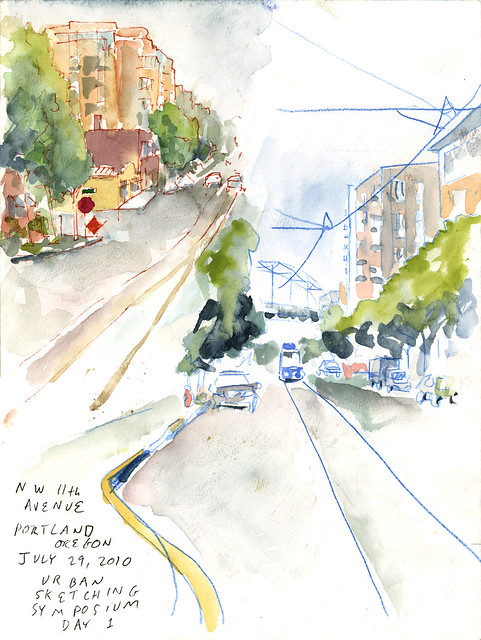
The first exercise we did was to draw with a non-black line. When you use a colored line, a few magical things happen, including: the line is no longer necessarily the darkest part of the sketch; objects that are the same color as the line take on a special power (as in the blue streetcar below); the mood and light of the scene shifts to be warmer or cooler, etc. Here's two views looking in opposite directions on 11th Avenue, one with a sanguine line, one with a blue line:
View in each direction, different colored lines

And here's a pink line. (I borrowed what I thought was a colored pencil for this one. Turned out to be a watercolor pencil, so my line dissolved as I colored. I did my best to work with it.):
Pink dissolving line

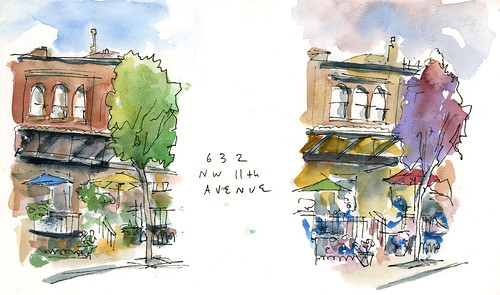
Next, we tried drawing the same scene twice, but coloring the two sketches differently. The first sketch was colored in a literal or realistic fashion, really trying to match the existing colors as seen. The second one was colored with an impressionistic or fantasy scheme. It was great to see people having fun with this exercise. In many cases, the sketch with the "wrong" colors was more successful. I suspect this is because you can convey more of the light and feel of a scene when you are not tied into trying to communicate color information.

Two sketches, different colors

Two sketches, different colors

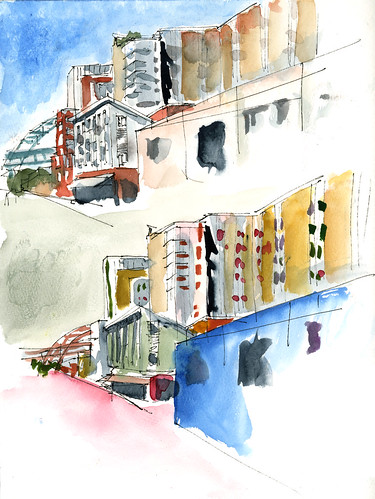
The final exercise was the really awesome one. Find a friend and try this yourself! We each did a line drawing, then handed it off to another sketcher, who did the colors. It was wonderful to see how someone else would color your drawing, and also wonderful to color a drawing you didn't have to do yourself. I was lucky enough to get paired with Kumi Matsukawa. Coloring in her sketch, I forgot it wasn't my own (except for a scary moment when I realized I'd painted a sculpture as if it was a tree--saved by some panicked blotting and scrubbing). And looking at Kumi's colors on my sketch, I find it hard to believe it's really my drawing.

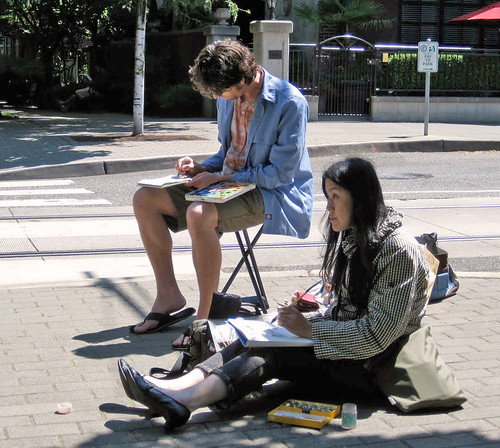
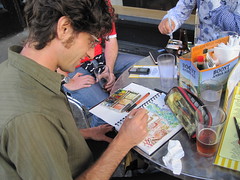
Here we are, hard at work (Photo by Don McNulty:
Kumi and Me

Here's Kumi's sketch, as colored by me:
collaboration (Jason's coloring on my line work)

And here's my sketch as colored by Kumi (and so much better than if I'd colored it myself!):
Kumi's colors, my lines

Cool stuff, right?

These exercises are all worth repeating and also work outside of the Urban Sketching context. I encourage you to try them out. Whether or not you love all the results as stand-alone pieces, it'll be fun and provide some new perspectives and insights.

Kumi and Pete Scully both did posts about their experiences in my color workshop--go check those out. (I suspect some other folks also blogged about this; drop a link in the comments and I'll add you!)

Wednesday, August 25, 2010

Struggling with Tanner Springs and The Fields

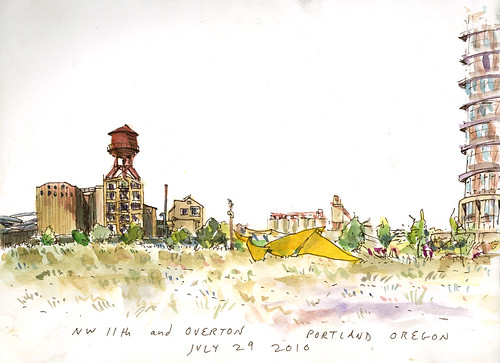
I think everyone at the Symposium was involved in at least one field sketching session that went to Tanner Springs Park. And why not? It's near the school, and it offers a real slice of (simulated) wild nature in a city block. It's a great park. But I don't think I'm the only one who found it frustrating to sketch. Something about the park's low vegetation, even lower water features, complex skeletal constructions, and the boring modern condos that surround it made it tough to find a satisfying vantage point and balance of detail and background. This frustration may have to do with why so many of us wandered up to the vast empty field to the north, the future site of The Fields Neighborhood Park Project. This less-planned space presented open vistas, a great view of the Fremont bridge, several abandoned factories, the Pearl District's iconic water tower, a giant yellow sculpture called "Rational Exuberance", dogs running exuberantly free, and (if you really missed them) more boring modern condos.

Here's the main sketch I did of Tanner Springs with one of my Urban Nature sessions. I guess it's fine, but I don't love it. And I really hate the paper I did it on (The blue Canson XL "Mix Media", one of our freebies; I like the other Canson papers we got quite a lot, but this one just does not jibe with my watercolor technique).
Tanner Springs

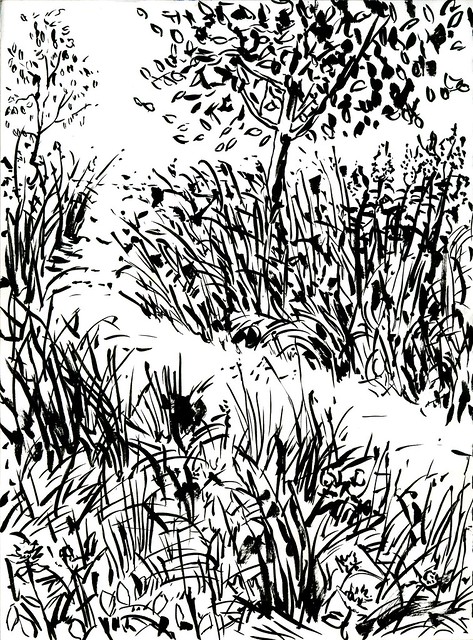
Halfway through the session, my group and I all discussed how danged challenging it was to sketch the meadow of the park. So that made it clear what our next exercise should be--sketch the meadow! Dive right into the hardest part and make it work! Here's my meadow sketch, done with a very nice Kuretake brush pen lent to me by Don Colley:
Meadow, Tanner Springs

Then we cut out of there for the yellower pastures of the Fields. Here's the first sketch I did up there:
Future Site of The Fields Neighborhood Park

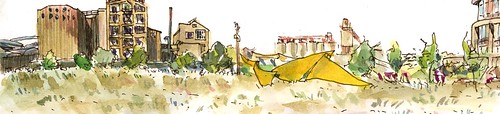
I wasn't too happy with it--the broad perspective and my desire to get everything in there led to an unbalanced result. Later on, I realized I like this sketch just fine if I crop it to a narrow strip:

Future Site of The Fields Neighborhood Park
Much better!

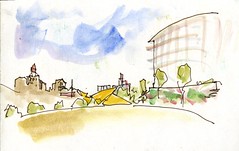
After disappointing myself with the sketch above, I did the thumbnail below to help someone else with their own composition. It was sobering to realize that this thumbnail was better (if much less complex) than the sketch I'd just poured far more time into.
Future Site of The Fields Neighborhood Park

It wasn't til I came back two days later that I got my favorite sketch of the Fields. The water tower is what drew me there originally, but it didn't make the sketch, nor did the sculpture. What turned out to be more important was an interesting angle on the bridge and buildings, plus including the people and dogs:
Future Site of The Fields Neighborhood Park

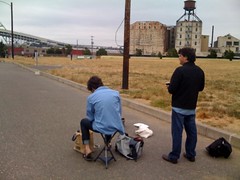
And here's a photo of me doing that sketch, alongside Matt Brehm. (photo by Liz Steele):
Sketching with Matt brehm and Jason das

Friday, August 20, 2010

Jason Das Finally Gets Around to Scanning Some of His Symposium Sketches

The Symposium was pure magic. Huge thanks to all involved. I'm planning to have a couple of more focused posts after this one, but here's everything that didn't fit into those.

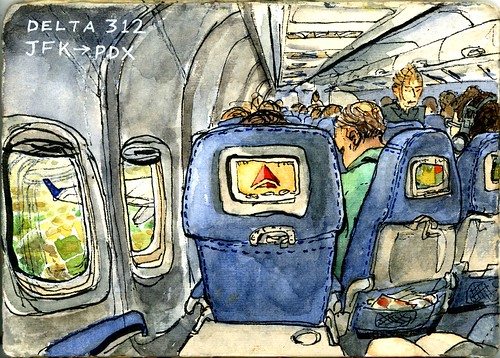
I did a sketch on the plane on the way in. I was pretty sure everyone else would have a plane (or train) sketch and I didn't want to feel left out. I also figured it'd be smart to warm up a bit.
Delta 312, JFK -> PDX

Yes, plunged into sketching pretty much as soon as we hit town. Here's Gérard Michel and Pete Scully as we found them upon arrival, sketching away!
Gérard and Pete

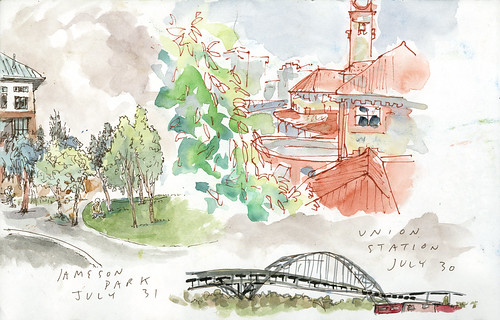
A lot of the sketching I got down during the Symposium was snatched in odd, quick moments. I was so busy, I didn't find time for "proper" sketches. Here's three scattered quick views sharing a page.
Three Portland Views
(If you look closely, you'll spot Gérard on his little stool sketching this view of Jamison Park.)

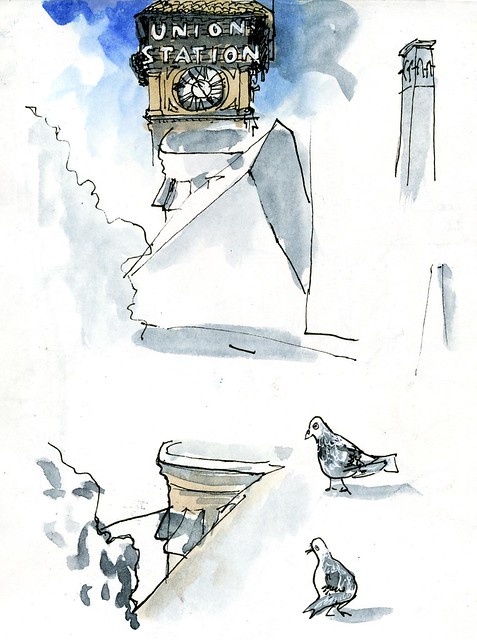
Here's some more, even quicker ones of Union Station. Three minutes is plenty sometimes!
Union Station

Sue van Etten caught me running up the Union Station footbridge (all of my Union Station sketches are from up there)...moving fast so I can squeeze in a little time for sketching if I'm lucky.
See Jason run

My sketch for Gabi is from that staircase, too:
Thank you!

Below, another view from the Union Station footbridge, and below that, fellow instructors Frank Ching, Isabel Fiadeiro, and Gabi Campanario relaxing after another crazy day.
Crane and Café

Here's photos of that one happening, courtesy Pete and Gabi:
IMG_1181
the sketching never stops
IMG_1185
IMG_1183

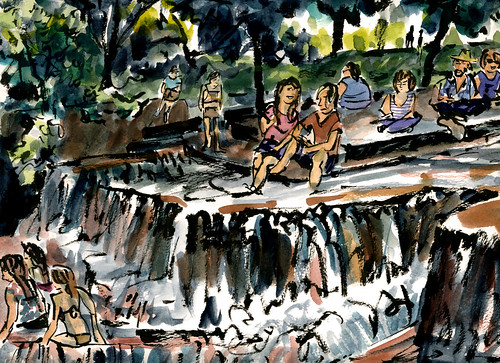
I led groups for the first three field sessions, so by the time Friday afternoon rolled around I was so relieved to not be on-duty that I splashed out to the middle of Ira's Fountain (perhaps my favorite place in all of Portland).
P1010244
Ira's Fountain

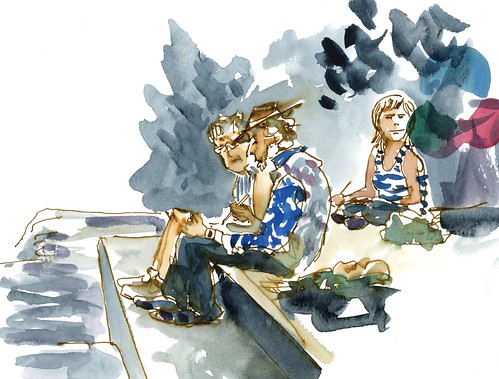
Can you spot Suzanne Cabrera, Lapin, and Liz Steele in there? Here's a closer view of Lapin and Suzanne:
Sketchers at Ira's Fountain

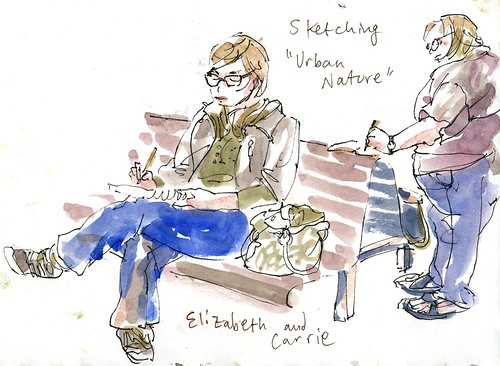
And for more sketching the sketchers, here's Elizabeth and Carrie in Jamison Park on Saturday morning:
Urban Sketchers Elizabeth and Carrie

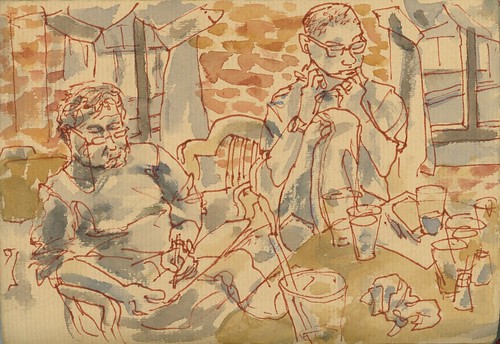
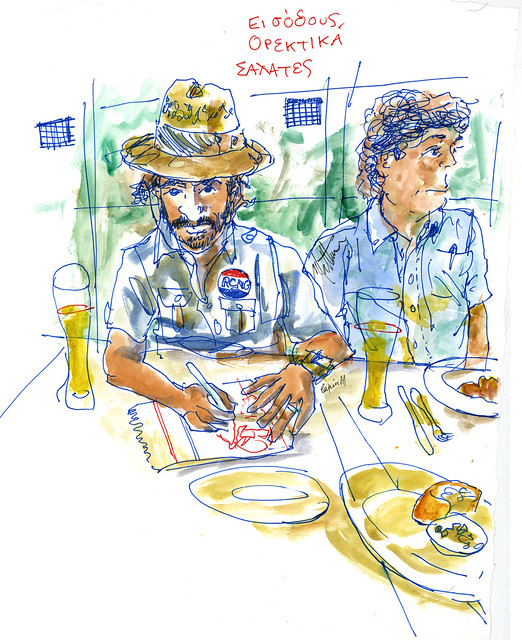
And finally (for this post), here's Lapin and Matt at dinner the final night. Lapin and I were sketching each other simultaneously. The original of this is rather huge, as I drew it right on the table cloth. (Here's his sketch of me.)
Lapin and Matt on a Table Cloth

Thursday, August 5, 2010

My results from Urban Color session

First of all, I thank to all of you who made this special event happen! Special thanks to Gabi. As Jason Das said in his interview with Gabi, there may be many sketchers in the world but without you, there wouldn't have been“ Urban Sketchers” nor wouldn't have had a chance to gather like this. Happy 1st Urban Sketching Symposium in Portland. Nice to meet you all in person!

Urban Color

experiment ( change fue)

In this session by Jason, we drew two same image but colored differently. That means I changed fue and I love the result.
The right image, I tried to capture the original color of the scene: a white car and green woods.
The left one I added a bit yellow on the car and made the woods look purple. I like the later more. Because it has much fresh
feel. This experiment tells me that sketching is not always copying the color we see or stick to the true color image but rather extract the ambience using your own palette. This idea made my following sketching easier.

collaboration (Jason's coloring on my line work)

This image, I drew lines and other person ( this time Jason) added color.( I also added color on his line work) This collaboration was also an eye opener. By doing this, I recognized my own tendency of coloring by comparing his way and how other person see and drew the same view differently. These are done at first day in the morning and this session excited me to become insomnia.

Sunday, July 25, 2010

Symposium lectures: From sketchbook to screen, by Jason Das

This is a brief summary of Jason Das' lecture, which is scheduled for Friday, July 30, at 5 p.m. and Saturday, July 31, at 1 p.m.

After you've got your sketches down on paper, the real magic comes when you share your work with the world! The internet has made self-publishing easy. But it can also be overwhelming, and you want to make sure your art looks its very best. We'll discuss technical and presentational aspects of scanning/photographing your sketches, optimizing and retouching them via image processing software, and posting them to the internet via your own blog, popular image hosting services, or social networking services.

Monday, May 31, 2010

Interview with presenter Jason Das

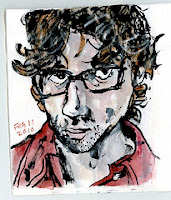
Atmospheric skies, delicate line work and bold black strokes, that's what first drew my attention to Jason Das' work.

As we visit his website, we discover all his different activities, as he puts it himself: blogs at Gas Water Nothing, contributes sketches to and serves on Urban Sketchers, shapes sounds in The Glass Bees, and saves the world with SuperVegan.

Jason works as an illustrator and also designs, builds and renovates websites. It was in 1995 that he created his first kind of website and he started sketch-blogging in 2005. For someone like me, who has just been discovering the net in the last couple of years, Jason is an artist I'm looking forward to meeting and learning from at the Symposium.

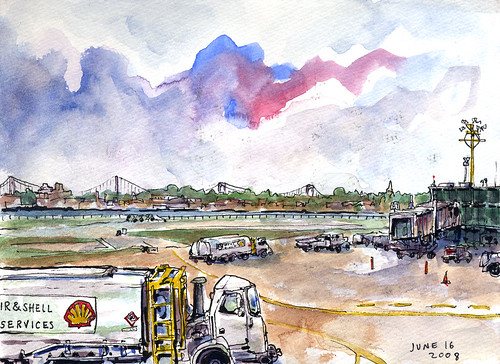
La Guardia Tarmac
La Guardia Tarmac

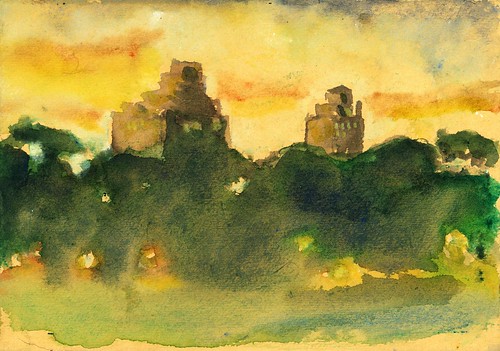
Prospect Park Sunset
Prospect Park sunset

From Smooch
view from Smooch

Around the Clock

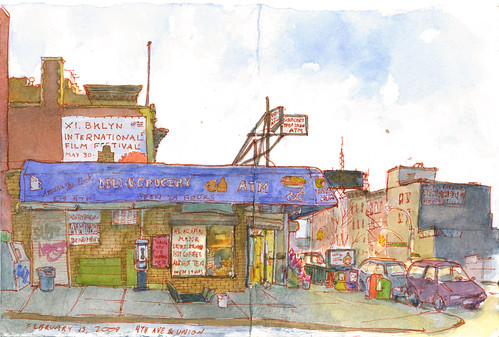
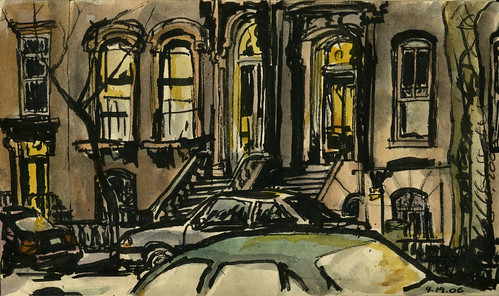
4th Avenue & Union

Multidisciplinary artist, illustrator and web developer. The web is the place you use to communicate not only about your work but also about things you care. You're interested in online communities and productive social networking. How do all those activities feed each other?

I worry they mostly undercut each other by using up my time and energy! Ideally, I'd like to find sucessful ways to synthesize and reach across any barriers between these different activities.

It can be tough balancing the people I cross paths with and work with. Animal rights activists or illustrators may not have an easy time understanding conceptual art. Postmodern fine arts people are often dismissive of illustrative art, and extremely insensitive to animal and environmental issues. Illustrators often forget to exert a point of view or sense of morality via their work.

There are great traditions of political art and illustrated storytelling, but I haven't (yet) found away to do that sort of work on a level that's satisfactory to me. Part of my problem is I'm not big on polemics and sloganeering--I'm the last guy you'll see wearing a "Go Vegan" T-shirt.

I do think that Urban Sketching can be a political, activist activity. There's great value in sharing honest reckonings of our everyday world. But obviously this is more true if you're documenting an immigration protest than some old interesting building mouldings.

The art and performance I do with the Glass Bees is containing more of my location-sketches, and our projects are increasingly dealing with sense of place and environmental issues, such as last year's "Venice Brooklyn" and our upcoming "Reading Governors Island" which will be part of the Figment Festival.

Meanwhile, as you well know, as great as it is to be involved in worldwide causes (like Urban Sketchers), we can't let that replace being active members of our local communities!

You choose to publish sketches that are quite different in style, technique and approach. Do you kind of plan it or it all depends of the time and tools you're carrying?

I very rarely plan it. I try to have a diverse set of materials with me, but even then I may misplace something, a favorite pen will run dry, or pan of color will run out and I won't get around to refilling it. The sketchbook I use most often these days has different textures and colors of paper in it, so that makes for some surprises, too.

I used to worry about not being a proper artist because I didn't have a "style." At the same time, I find far too many artists (and not just visual artists!) are trapped by their style. Of course, the more work I do, however varied it may be, some elements of style do become recognizable. I won't be surprised if my artwork is a lot more consistent a few decades from now.

In some of your sketches you will use big black strokes made by a brush pen or by a marker. As a sketcher I find it really difficult to make such strong lines work and I admire how you're able to use them so well. How did they come up in your work?

I can be pretty impatient. The more ink I can put down at once, the faster the sketch is finished. Also, if I'm sketching an unposed animate subject (passengers on the subway, kids in the park, animals), working fast is a must!

Another good use of big black strokes is this: I'll use a brown or sanguine line for finer linework and a black brushpen for shadows or other dark areas. This way I'm not stuck with the countours being the boldest element.

The lecture you will be giving at PNCA is titled 'From sketchbook to screen'. Tell us about your vision of the net and how it can help sketchers and artists. Sometimes it can be very time consuming to share our work online and that take us away from spending more time drawing. What are the benefits of sketch-blogging?

As time consuming as it is, it's a lot easier than it would have been before we had the Web. I suppose we'd be organizing touring shows of our sketches, and mailing them around the world, or publishing paper magazines. A relatively tiny amount of work would be seen by a relatively tiny amount of people, and it would all be frightfully expensive.

If you are only sketching for your inner self, there's no need to share. But as soon as you want more people to see your work, the internet is the way to go. I love the feedback I get from fans and fellow sketchers all over the world, and I love discovering other people's work.


The Internet has made sharing information possible in a way that is unprecedented in human history. I find this tremendously exciting. The barriers to entry, at least for most people in the First World, are extraordinarily low. Anyone can publish their own content, and see everyone else's. Coping with all this content is a challenge of course, but what a great problem to have! As I'm more experienced with computers and the Internet than many of my fellow sketchers, I'm eager to help them make the most of the tools available, and understand fundamental concepts so they don't get left behind by rapidly evolving technology.

• Jason's weblog.
• Jason's work in flickr.

Wednesday, May 12, 2010

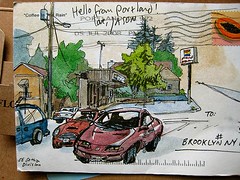
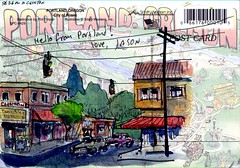
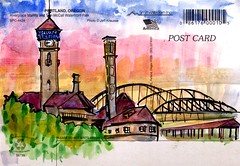
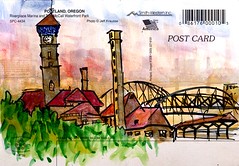
Postcards from Portland

I once regarded sending postcards to friends and family while traveling a thankless chore. Then I started Urban Sketching! It may still be a chore, but it's far from thankless.

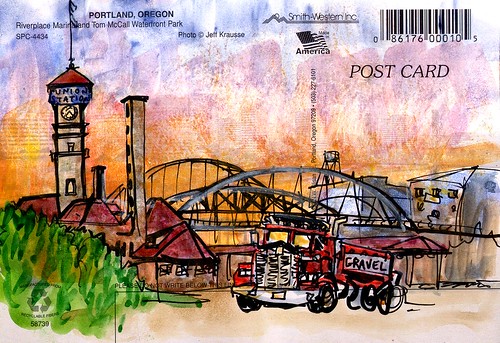
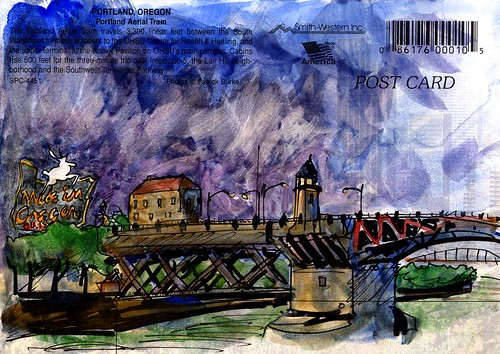
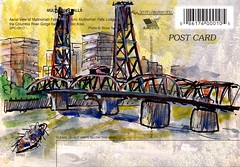
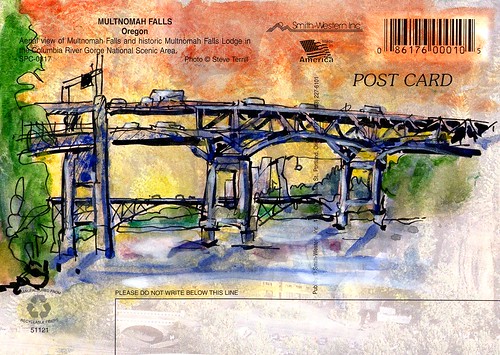
The main lesson I've learned since doing these two years ago is that it's better to use proper watercolor paper in postcard-form than attempt sketches on the slick, already-printed-on backs of commercial postcards.

pdx postcards 9 pdx postcards 3

There's no need to think up words, and even if you sketch the same thing for multiple people, each version will be unique.

pdx postcards 7

pdx postcards 5 pdx postcards 2

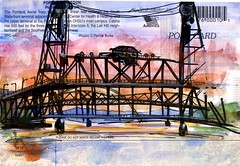
I promised you bridges, didn't I?

pdx postcards 1

pdx postcards 4 pdx postcards 8

pdx postcards 6

(I did quite a few more than these, but didn't have a chance to scan them all before they were mailed.)

Monday, May 3, 2010

Some of Portland's Waterways

For most of my life, I thought Portland was on the Pacific Ocean, or at least on an adjoining bay or harbor. In fact, it's quite a ways inland and not at all a coastal city. But Portland is a river city--it actually reminds me a lot of Pittsburgh where I grew up. They also get a lot of rain (though not in midsummer when we'll be there!) and it all makes for a very water-oriented place.
I spent a month in Portland in the summer of 2008, and these are a few of my sketches of water features, natural and human-made.

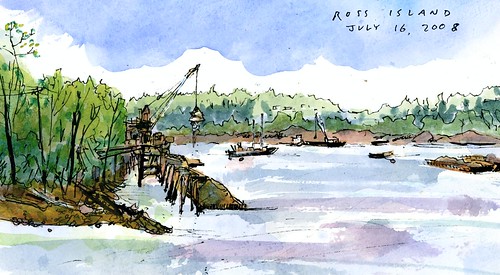
The Willamette River chops right through town, separating the East side from the West side. A bit south of downtown is the still-active Ross Island Sand and Gravel Company. Here's a view of their works, as viewed from the Springwater Corridor Trail as it emerges from Oaks Bottom Wildlife Refuge.

Ross Island (cropped)

That such a mix of the natural and industrial exists mid-city nearby to residential and commercial neighborhoods is, well, very Portland!

The Columbia river forms the northern border of the city and also acts as the state-line between Oregon and Washington. It's a bigger river but adjoins much less populated parts of town than the Willamette. The two rivers converge a bit north of the city (but an easy bicycle ride away) around Sauvie Island. I sketched this beach scene there:

Sauvie Island 2

I suspect that most river pictures of Portland feature a bridge or two (or five). The bridges are quite indeed sketchable. But I'll save my bridge sketches for another post.

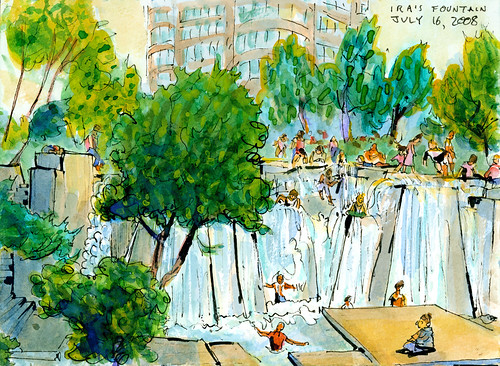
Portland is also home to some tremendously cool public fountains, fountains that the public are very much encouraged to get wet in! On a hot summer's day, can you imagine anything better in the middle of downtown than Ira's Fountain?

Ira's Fountain

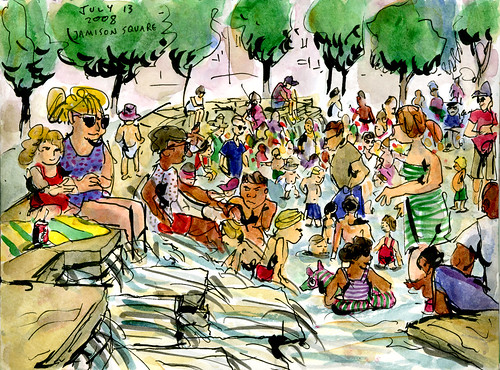
I can't even imagine Ira's Fountain--with its cliffs, falls, and pools--being legal anywhere else in the US. If you want a mellower fountain, perhaps you'd prefer Jamison Square, which has its very own artificial tides.

Jamison Square

(The Salmon Street Springs fountain is also lots of fun. I don't have a sketch of it, but check out the one Gabi did.)