Showing posts with label Simo Capecchi. Show all posts

Tuesday, August 17, 2010

Portland bridges


I've enjoyed Portland so much. The city and all the people I've met there. I'm with no scanner and slow connection here, but I upload my version of the famous bridges. It has been worthwhile drawing (and blogging) in the past few years if, like bridges, it connected me with so many interesting people, all around the world.
I was freezing when we where drawing on the pedestrian bridge on the station. Than I talked with Don and Linda about growing childs and brothers that fight too much, and I got some usefull advise. Amazing things pass trought drawings.
Few minutes before leaving, while Gabi was already worried, waiting for us in the train station, I lost myself in Powells bookshop and bought for 2 dollars this nostalgic souvenir of the city: 1952.
Thanks to everybody, it has been a great opportunity for me.

Monday, August 2, 2010

Sketched!

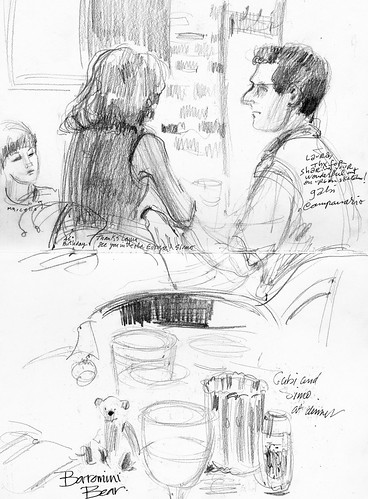
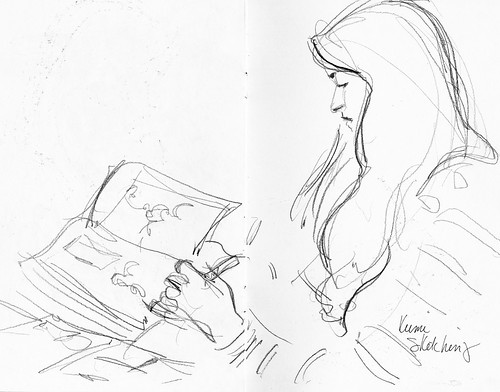
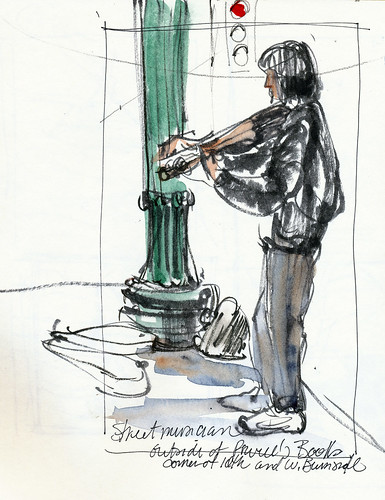
The symposium weekend was the kind of event that, yes, made an impact as it took place, but will certainly inspire and instruct and delight for a long time to come. Home for less than 24 hours, I'm already feeling its impact. For various reasons, I was not 100% myself while I was there, but still managed to leap in and do some sketches---here are some.Urban Sketchers symposium: Gabi, Simo, Marcello, and BorrominiUrban Sketchers symposium: Isabel's talkUrban Sketchers symposium: KumiUrban Sketchers symposium: musician More to come!

Friday, July 16, 2010

Symposium lectures: Naples in a collaborative sketchbooks project, by Simo Capecchi

This is a brief summary of Simonetta Capecchi's lecture, which is scheduled for Thursday, July 29, at 1 p.m. and Friday, July 30, at 5 p.m.


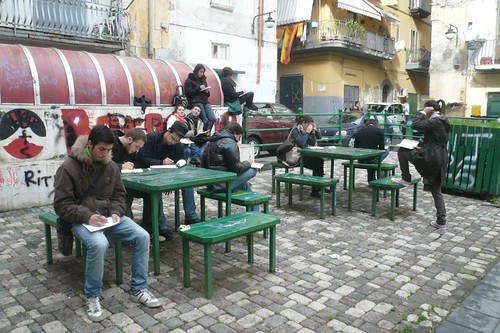
Since 2006, I curated the first italian annual exhibition on travel sketchbooks for a Neapolitan's books fair. Besides conferences, events and invited artists, I dedicated one section to a collective exhibit to recount the city of Naples from different points of view, both with images and words. In past four editions I collected almost 200 sketchbooks from various authors, involving artists, architects, graphic designers, illustrators but also non professionals and lots of children. A book (see excerpt above), a blog and a video channel document this experience and the international relations that have grown from it.

Tuesday, June 29, 2010

Simo Capecchi's sketching gear


Lately I like the Bic Cristal, the old biro we used at school, gray and soft enough to substitute my pencil. With Payne's gray it makes a perfect combination for me (similar bic + one color drawings, here and here).


I do make the effort of using colors sometimes, but you can tell which are my favourite... (this drawing here). I'm scared of brilliant colors and of thick black lines.


Here is the entire content of my sketching bag, an old military waterproof one that I have been using for years.
Together with Pentel waterbrush and a flat brush, I use a waterproof Uniball Signo 0.38, a sharpener, B6 pencils (mostly for drawing persons) and a pills container for water. Watercolors tablets are Windsor & Newton, AA serie.


I'll leave in 10 days for San Francisco and maybe my grays will be good enough for the city fog. Thanks to all the participants who are sharing their drawings here,
see you all in Portland!

Thursday, May 20, 2010

Matthew and Simonetta, architects in sketchbooks -2

Matthew and I had a sort of conversation on our approach to urban sketches, instead of a simple interview. This is the second part of it.

Largo Baracche
Simo Capecchi's students drawing in the center of Naples.

Matthew: When you are trying to teach sketching (or how to use a sketchbook), what are the most common difficulties you encounter with your students, and how do you overcome these challenges?

Simonetta: With architecture students to whom I lectured in November this year, I had great difficulties in convincing them that drawing freehand is going to be useful even if they will design with the computer. They are intimidated by the artistic aspects of drawing and seldom use colors (their sketchbooks here). I can understand this, since I have drawn with ink pen and rulers for 15 years as well. I have been a student in the ’80s before CAD, and even in that period the value of freehand sketches was not so appreciated in Italian Architecture faculties. It’s a common idea that the only way to draw is to have a "natural" talent for it, so the main difficulty is to convince students not to give up and dedicate time to drawing: they often feel exhausted after only 30 minutes! Usually I show my own process, bringing them my old notebooks as a student with all my bad pages to demonstrate that anyone can improve their skills with practice.

Largo Pignasecca

Simo Capecchi, view from the faculty windows, drawing with students, nov. 2009.
Ink pen on Moleskine large.


Matthew: Interesting – I have almost the exact same experience! I believe that both digital graphics and hand drawing are essential skills for designers, but it does take a greater commitment and more patience to really develop hand drawing skills. I have found that if students do learn to draw freehand, they value the skill so much more than being able to draw with digital tools. They have a greater sense of achievement, and I think this carries over into many other areas. But the biggest problem I have is that students tend to resist drawing frequently, and they don’t always see the value of studying other people’s drawings. But nevertheless it is so rewarding working with students and seeing their successes.


Matthew Brehm, nov 2009, sketchcrawl in Moscow ID. Ink pen on Moleskine pocket.

Matthew: How do you keep up with all of the wonderful online sources for sketching examples – blogs, flickr, etc.?

Simonetta: I started a blog in 2006 being unaware of the revolution it had begun, in terms of time I would devote to it and also of possibilities to comunicate with people all over the world. I'm still suffering the consequences of it, Urban Sketchers being the most “dangerous” and involving one. Now I mostly use a blog and flickr (plus closed projects + + + + +), and it’s already a big effort for me to keep them updated. Years ago I was among the first ones to use Issuu, after I saw Lapin use it. It has such a good resolution but it takes time to prepare, so till now I uploaded just a few sketchbooks on Issuu.
I'm also preparing a video channel to document a group of 50 Moleskine of various authors I collected in my exhibitions on travel sketchbooks in Naples. They are already on flickr and edited in a book, but a video is the best way to get the feeling of the intere sketchbook, now that the quality is much better than before. I don't like facebook and twitter, those are really too much for me. I’m already spending almost the same time on the Internet than drawing while I'd like to dedicate more time to real life.


Matthew Brehm, drawing with students in Portland, 24th Sketchcrawl sept 2009.
Moleskine watercolor Large.


Matthew: I’m always in awe of artists who are able to be so prolific in their sketching and especially when they manage to share so much of their work online. You’re right that Urban Sketchers is “involving” – but I never feel as if I have wasted my time when I see all the wonderful drawings and stories. I do feel overwhelmed sometimes, and, as you mention, occasionally I fear that I’m spending too much time looking at other sketches instead of sketching myself. But still, the communication that the internet has allowed is absolutely amazing – the connections that have been made and that will continue at events like the Portland Symposium, this is unprecedented. Sketching on location has had a social aspect to it for a very long time, but the number of new connections being made around the world is a relatively new phenomenon. It’s exciting to be part of this, even if it requires a time commitment to keep up with the new work that appears every day. (Matt's blog and Flickr)


Matthew Brehm's students in Rome, summer 2009.

Simonetta: From the Internet and our community of sketchers I get new ideas every day, but I also fear the possibility of being confused and loose my personal voice. I hope in the long run we are not going to draw in the same way, from Naples to Moscow, from Singapore to Sidney! I can’t wait to meet you and all the Portland participants and I’ll be very happy to find, besides all we have in common, deep differences among us...

Monday, May 17, 2010

Matthew and Simonetta, architects in sketchbooks -1

Mattthew and I had a sort of conversation on our approach to urban sketches, instead of a simple interview. This is the first part of it.

Matthew
: How often do you sketch, and how much time do you typically spend on a single sketch?

Simonetta: Sometimes I do not open my sketchbooks for days, sometimes I draw the entire day. I can spend a minimum of 15 minutes on a sketch, and 30 minutes to 1 hour on a watercolor. Lately I'm trying watercolor on loose pieces of paper (50x25 cm) and it takes me longer. I could draw for hours if I'm not interrupted, I'm never tired of it, I really like the feeling of being completely concentrated on it.

Matthew: I can also go for days without drawing, because I’m so often busy with work and the rest of my life. But I am almost always thinking about drawing, so when I get the chance I really enjoy it. Because I teach architecture, sketching is part of my focus with when I’m working with students, but sometimes I feel like I don’t sketch for myself quite enough! When I am using a sketchbook, I usually just spend 15-20 minutes on a drawing. When I use loose paper (23x31cm, or 9”x12”) I try to spend about 30-45 minutes on a drawing, usually longer if I’m using watercolor or a mix of ink and watercolor. I’m usually happier with the results if I keep the sketch relatively brief, but some subjects require more time and patience.
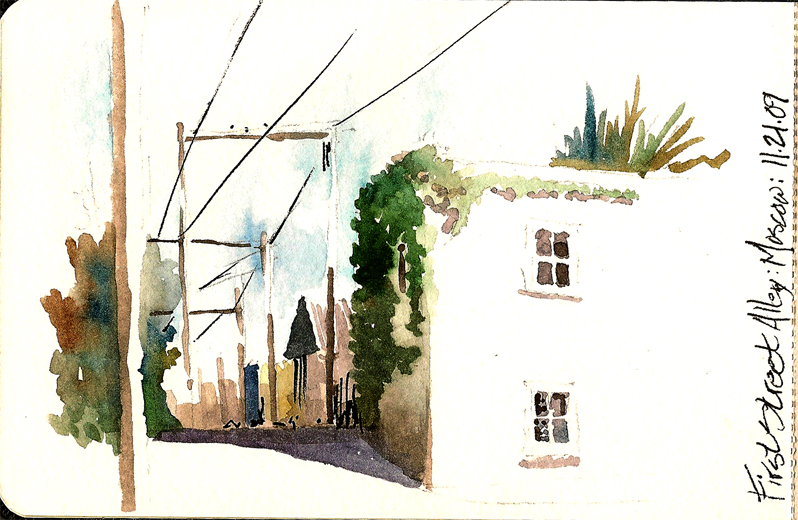

Matthew Brehm, Watercolor on Moleskine sketchbook pocket size (14x9 cm), Moscow ID.

Simonetta: When my childs where younger, I used too very small sketchbooks like this on Ustica island (14x9 cm), that I do not prefer anymore. Since I have more time and maybe because my eyes are not as good as before, I'm enjoing the experience of bigger pieces of paper even if is not that practical to carry on travels. I bought new brushes n.20, I use more water... and it does takes more than half an hour.

palazzo Donn'Anna

Simo Capecchi. Palazzo Donn'Anna Napoli. Watercolor on Arches paper (56x23 cm), 1 hour approx.

Matthew: What are your preferred sketching subjects?

Simonetta: I guess I feel more comfortable when I draw buildings, since I studied as an architect. I love the best to draw cities and landscapes and people from a panoramic view. I always try to go on top of terraces, towers, hills... this goes with my passion for climbing, both mountains and trees.

Matthew: I am also more comfortable with buildings and urban spaces, which is no surprise since I also studied and now teach architecture. My preference is to be in the space I’m trying to draw, with something dramatic about the perspective and the light – I almost can’t draw on grey, rainy days because I need to see light contrast to become interested in a particular view. I have been participating in a weekly figure-drawing session, trying to break my aversion to drawing people, and this has been a great experience. It’s very different than sketching in an urban environment, but I think it’s good to vary the subject matter and the media on a regular basis.
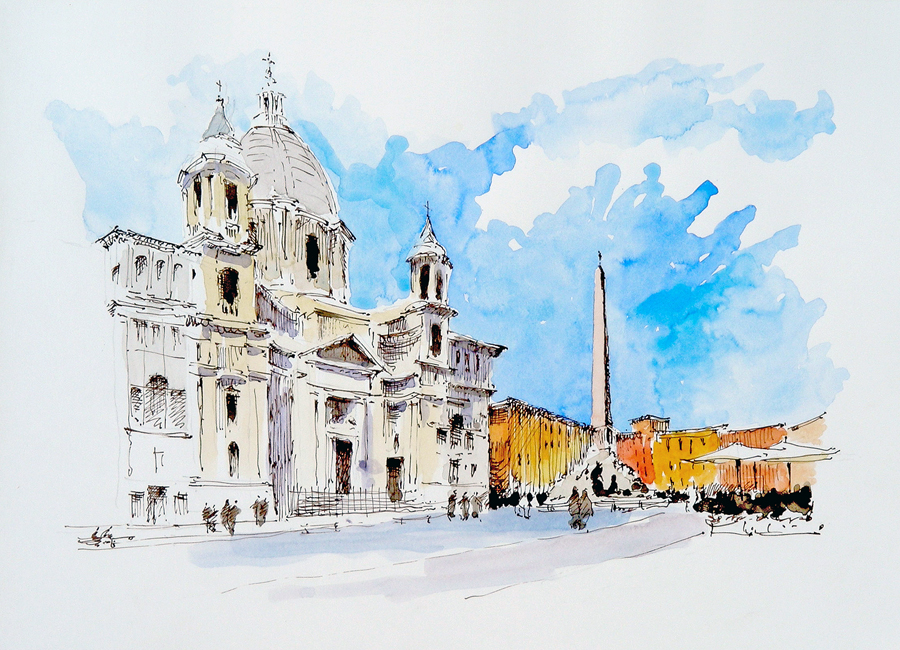

Matthew Brehm, drawing with students in Rome, Piazza Navona. Watercolor and ink.

Simonetta: I agree. I had a weekly figure-drawing session too, with Spanish painter Pedro Cano that has been a very intense, almost shocking experience: 30 minutes sessions on 50x35 cm. paper with no pencil admitted. Some (strange) drawings of mine here. I like to draw figures from ancient statues, for instance at the Archeological Museum, much more easy.

Afrodite
Simo Capecchi, Archeological Museum in Neaples. Watercolors on Arches paper 20x30. 20 minutes.

Matthew: Do you make plans in advance to sketch particular subjects, or are you more spontaneous?

Simonetta: I have dedicated sketchbooks like: Naples ink, Naples watercolors, Appennins, Bologna... for places or cities where I often go, I start a new book for each trip or long vacation and I have a small sketchbook for daily life, conferences and unplanned drawings. I also made sketchbooks as a project, like these ones for an exhibition, on a square in Bologna and about two days in Paris.

Matthew: I have some dedicated sketchbooks as well: University of Oregon campus, University of Idaho campus, and I collect my loose sheet sketches into portfolios for a particular time – such as each summer I have spent in Rome. I am trying to simplify, and use only one sketchbook for notes, journal entries, and impromptu sketches, but it’s not easy because I enjoy the properties of different books and papers. Most often, I don’t make plans to draw something specific, but occasionally I will see a certain kind of sunlight on a building and make a mental note to return at that time another day. This happens in Rome very often, because I am usually busy with students and need to come back to sketch when I have free time.

Simonetta: I know you are leaving for Rome again, good luck with your students and see you soon, in Naples and then in Portland!

Second part of this post will follow in a few days...