During our monthly sketchcrawls in Seattle, Frank Ching is just another drawing enthusiast, passing his sketchbook around, giving feedback, asking questions and sharing the jovial atmosphere. But when you see his work, you realize Frank is no accidental sketcher. Over 35 years, he has taught generations of architects how to draw and has written
numerous best-selling books about architectural drawing and design that have been translated to over 16 languages.
I've met many academics of different fields before, but never someone as approachable and generous as Professor Ching. He recently retired from full-time teaching at the University of Washington, so I'm especially grateful that he will share his talent and teachings with us in Portland.
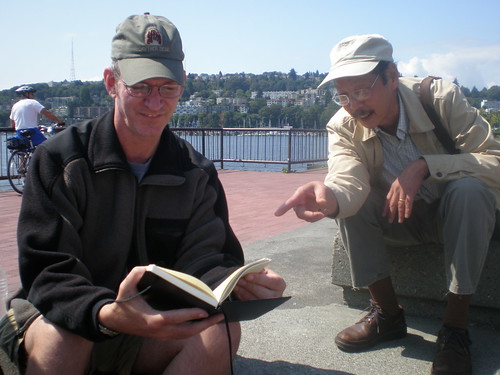
A sketchcrawl participant browses through Ching's sketchbook.
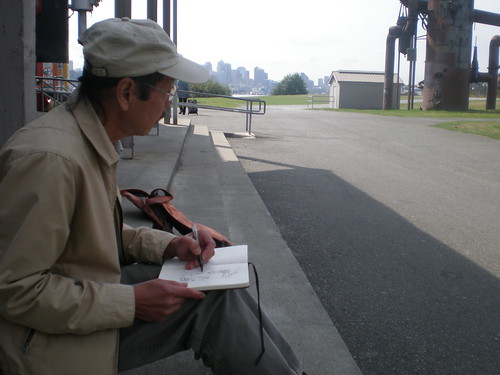
Ching drawing at Gas Works Park in Seattle.
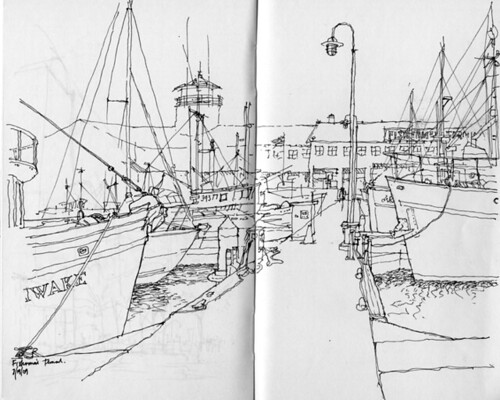
A sketch of Seattle's Fishermen's Terminal.
How did your career teaching architectural drawing start? What attracted you to it?Toward the end of my year's service in
VISTA in 1972, I got a call from a former classmate who was teaching at Ohio University, asking me if I were interested in interviewing for a teaching job. Not having any plans or commitments, I agreed to drive down from Cleveland to Athens, Ohio, for the interview. I remember the chair of the department of architecture asking me if I thought I could teach drawing and being young and naive, I of course said yes. So it was a fortuitous set of circumstances that led me to become an "accidental" academic.
How do you get your students to improve their skills? What's your teaching methodology?I have come to believe that iteration — constant and repetitive practice — is important to learning visual and drawing skills. We can learn more from doing many smaller sketches rather than one or two larger drawings. I also think that drawing from observation, on location, and developing visual acuity should provide the basis for drawing from the imagination in design. But above all, design students should understand that drawing is a language with which we communicate our ideas and observations.
What tools do you use to sketch?My palette is very simple: a fountain pen and a sketchbook. While I admire others who handle other media so well — pencils, watercolors, pastels — I have come to really love the tactile feel of an ink nib on paper and the fluidity and incisiveness of the strokes. And the abstract quality of an ink-line drawing is actually very liberating for me.
What do you recommend to people attending the Symposium as preparation?I don't have any specific recommendations. Drawing occurs in the moment. All that will be required is to be present, be observant, and respond to the qualities of a place.
Have you been to Portland? What are you looking for in the Symposium experience?Despite living in Seattle for almost 30 years, I have only been to Portland a handful of times. I fondly recall, however, the pedestrian-friendly scale of the downtown area and I'm looking forward to meeting and working with others who love drawing. Now that I am retired from active teaching, these kinds of workshops are my favorite ways to teach as well as learn.
Some of Professor Ching's books: