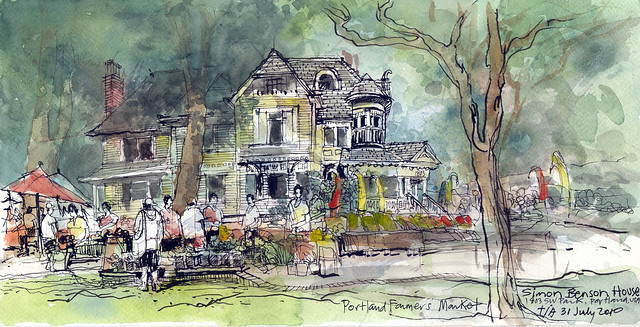
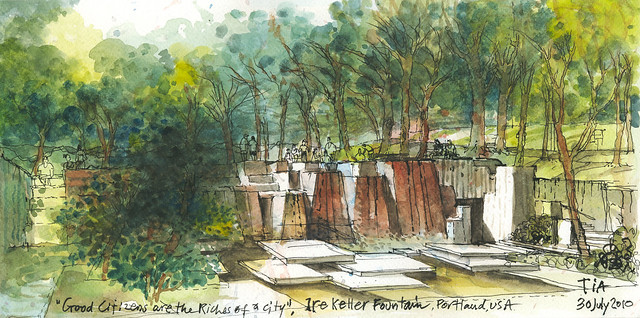
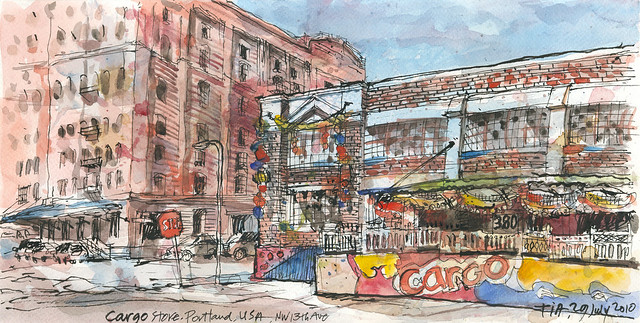
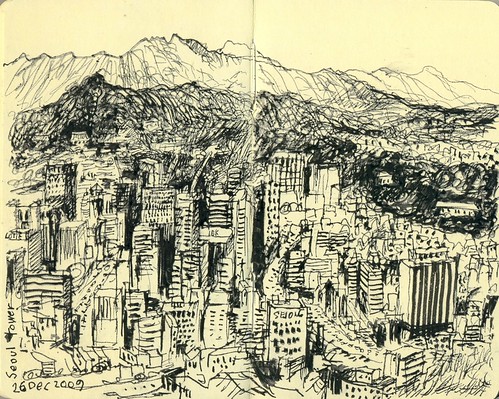
When I first encountered Tia Boon Sim's drawings during my daily scroll down the
Urban Sketchers blog, I stopped and looked for a long time. Her work is so lively, so interesting and so full of texture and life! The word that best describes her drawings is HUMAN.
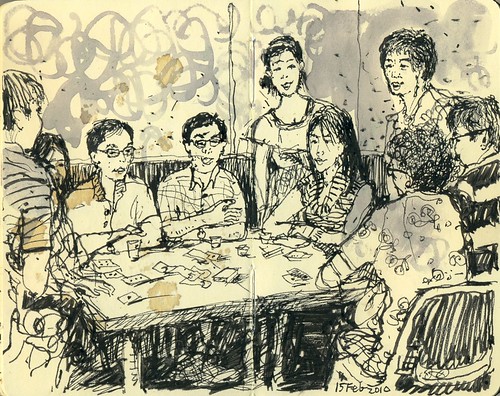
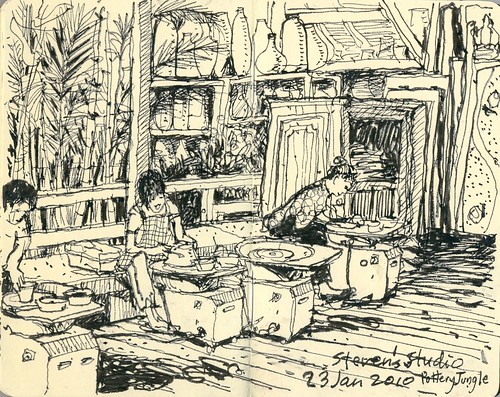
Tia's posts are often full of the joys of her daily life. We see her pottery studio, her many students out sketching, her family playing cards at New Years. Her work gives the sense of someone who lives as an artist through everything she does. As one reads her posts it also becomes clear that Tia passes that passion on to her students.
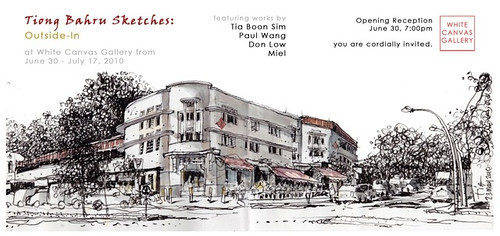
An architect and educator, Tia is also involved in many other forms of artistic expression, including her gorgeous location drawings. I recently had the chance to ask her a few questions via email and hope you enjoy reading her thoughts below. I look forward to meeting Tia in Portland this summer!
Location drawing, painting, design, architecture, sculpture, pottery: your interests in the arts are diverse. Do you have any thoughts to share regarding how the differing disciplines inform each other? Is there one form of communication that seems closest to you or do you enjoy them all equally?Like most Singaporeans of my age, I devoted most of my life working in the day and spending quality time with the family over the weekends. It is when I was studying alone in Italy and New York that I started to do location drawings faithfully trying to record my adventures and journeys in the sketchbook. I was lucky to have opportunities to dabble with architecture, sketching, painting, designing, sculpturing and pottery at different stages of my life. I think it is because of my vocation as an art and design educator that allows me to have such diverse disciplines. However, there is seemingly a common thread in these different disciplines. I think, curiosity is the catalyst and visual thinking is the tool or vehicle to allow these different disciplines to take place at different stages in my life.
In my case, I have been extremely blessed to have formal private art training under a Singapore’s pioneer artist at a tender age of 10 before I enrolled into School of Architecture at the age of 19. During that time, taking art lesson was uncommon compared to taking piano lessons. Nowadays, it is common for children to take art, ballet, piano, violin, aikido, taekwondo and swimming lessons.
Do you think that architectural and design students can benefit from location drawing? If so, how?In my view, architectural and design students will definitely benefit from location drawing. Location drawing provides the students with an opportunity to acquire observational skills. When you are doing location drawing, attention to the details and absorbing the mood are two important skills students need to develop to a stage when they can see and sense with their own interpretations. I also tell them to draw what they see and not what they know as far as location drawing is concerned.
I know that in addition to the University of Singapore you attended Pratt Institute in Brooklyn, New York. Can you comment on the similarities or differences between the educational style for the arts in the East and West?When I went to Pratt Institute, I was about 25 years older compared to my classmates in the Art and Design Education program. I think I was the only foreign student in that program because it was also the program primarily for American professional artists to get certification in order to teach art in schools. I had a relatively easier time being more mature with an architectural background. I like the American system whereby I found it very open and democratic. I came from a relatively rigid system that if someone failed one subject, he or she had to repeat all the subjects for another year. With the American credit based system, one only needs to retake the failed subject or course. However, we are now adopting the best from British and American academic system and thus, our younger generation is very lucky to be given a more open and democratic educational landscape. Education for the arts is only been looked into seriously in the past three years with the setting up of School of the Arts that offers Visual Arts, Music and Theatre at the Secondary School level. In the past, teachers in the schools used the class periods meant for art and music lessons to teach supposedly important subjects such as Mathematic, Languages and Sciences. Even today, teachers who are assigned to teach art and music are usually not trained in the specific area. The good news is these are going to change next year as our educational authority has encouraged the recruitment of professional artists and music teachers.
What are you looking forward to in Portland this July?I am excited about the Sketching Symposium and looking forward to meeting all the like-minded people who love to sketch on location. I am almost certain all of the participants will want to get that satisfaction and elation we all experienced when we finished a sketch with excitement and satisfaction.
What would you hope that symposium attendees would take away from working with you in Portland this summer?I hope to share with the participants the Asian background that I hope will provide a balanced perspective to the Symposium. I will like to introduce countries in Asia, our cultures, people and habits so as to make USK a truly global platform to share and to learn.