Thursday, May 20, 2010

Matthew and Simonetta, architects in sketchbooks -2

Matthew and I had a sort of conversation on our approach to urban sketches, instead of a simple interview. This is the second part of it.

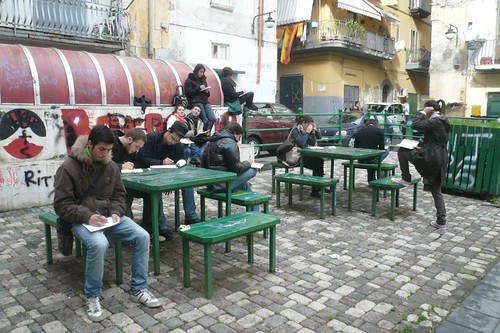
Largo Baracche
Simo Capecchi's students drawing in the center of Naples.

Matthew: When you are trying to teach sketching (or how to use a sketchbook), what are the most common difficulties you encounter with your students, and how do you overcome these challenges?

Simonetta: With architecture students to whom I lectured in November this year, I had great difficulties in convincing them that drawing freehand is going to be useful even if they will design with the computer. They are intimidated by the artistic aspects of drawing and seldom use colors (their sketchbooks here). I can understand this, since I have drawn with ink pen and rulers for 15 years as well. I have been a student in the ’80s before CAD, and even in that period the value of freehand sketches was not so appreciated in Italian Architecture faculties. It’s a common idea that the only way to draw is to have a "natural" talent for it, so the main difficulty is to convince students not to give up and dedicate time to drawing: they often feel exhausted after only 30 minutes! Usually I show my own process, bringing them my old notebooks as a student with all my bad pages to demonstrate that anyone can improve their skills with practice.

Largo Pignasecca

Simo Capecchi, view from the faculty windows, drawing with students, nov. 2009.
Ink pen on Moleskine large.


Matthew: Interesting – I have almost the exact same experience! I believe that both digital graphics and hand drawing are essential skills for designers, but it does take a greater commitment and more patience to really develop hand drawing skills. I have found that if students do learn to draw freehand, they value the skill so much more than being able to draw with digital tools. They have a greater sense of achievement, and I think this carries over into many other areas. But the biggest problem I have is that students tend to resist drawing frequently, and they don’t always see the value of studying other people’s drawings. But nevertheless it is so rewarding working with students and seeing their successes.


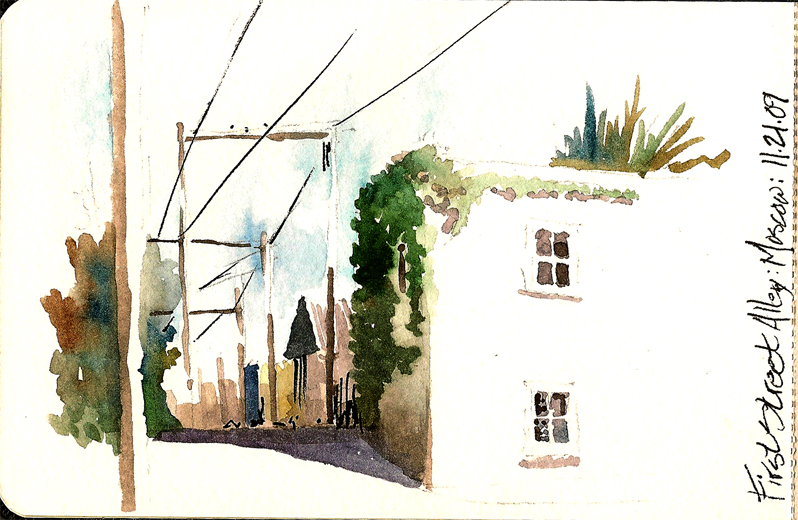
Matthew Brehm, nov 2009, sketchcrawl in Moscow ID. Ink pen on Moleskine pocket.

Matthew: How do you keep up with all of the wonderful online sources for sketching examples – blogs, flickr, etc.?

Simonetta: I started a blog in 2006 being unaware of the revolution it had begun, in terms of time I would devote to it and also of possibilities to comunicate with people all over the world. I'm still suffering the consequences of it, Urban Sketchers being the most “dangerous” and involving one. Now I mostly use a blog and flickr (plus closed projects + + + + +), and it’s already a big effort for me to keep them updated. Years ago I was among the first ones to use Issuu, after I saw Lapin use it. It has such a good resolution but it takes time to prepare, so till now I uploaded just a few sketchbooks on Issuu.
I'm also preparing a video channel to document a group of 50 Moleskine of various authors I collected in my exhibitions on travel sketchbooks in Naples. They are already on flickr and edited in a book, but a video is the best way to get the feeling of the intere sketchbook, now that the quality is much better than before. I don't like facebook and twitter, those are really too much for me. I’m already spending almost the same time on the Internet than drawing while I'd like to dedicate more time to real life.
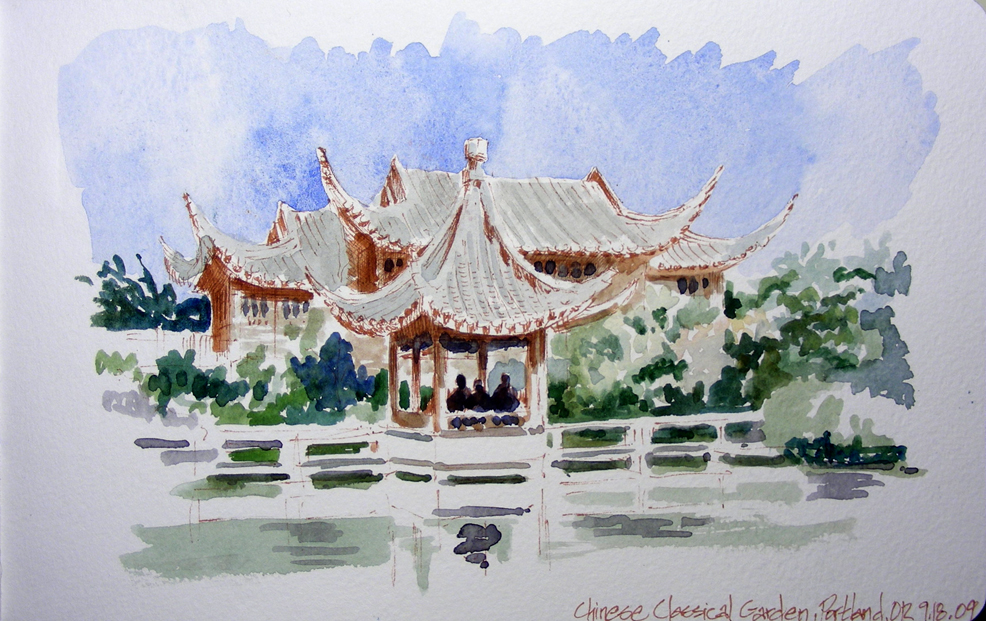

Matthew Brehm, drawing with students in Portland, 24th Sketchcrawl sept 2009.
Moleskine watercolor Large.


Matthew: I’m always in awe of artists who are able to be so prolific in their sketching and especially when they manage to share so much of their work online. You’re right that Urban Sketchers is “involving” – but I never feel as if I have wasted my time when I see all the wonderful drawings and stories. I do feel overwhelmed sometimes, and, as you mention, occasionally I fear that I’m spending too much time looking at other sketches instead of sketching myself. But still, the communication that the internet has allowed is absolutely amazing – the connections that have been made and that will continue at events like the Portland Symposium, this is unprecedented. Sketching on location has had a social aspect to it for a very long time, but the number of new connections being made around the world is a relatively new phenomenon. It’s exciting to be part of this, even if it requires a time commitment to keep up with the new work that appears every day. (Matt's blog and Flickr)


Matthew Brehm's students in Rome, summer 2009.

Simonetta: From the Internet and our community of sketchers I get new ideas every day, but I also fear the possibility of being confused and loose my personal voice. I hope in the long run we are not going to draw in the same way, from Naples to Moscow, from Singapore to Sidney! I can’t wait to meet you and all the Portland participants and I’ll be very happy to find, besides all we have in common, deep differences among us...

Monday, May 17, 2010

Matthew and Simonetta, architects in sketchbooks -1

Mattthew and I had a sort of conversation on our approach to urban sketches, instead of a simple interview. This is the first part of it.

Matthew
: How often do you sketch, and how much time do you typically spend on a single sketch?

Simonetta: Sometimes I do not open my sketchbooks for days, sometimes I draw the entire day. I can spend a minimum of 15 minutes on a sketch, and 30 minutes to 1 hour on a watercolor. Lately I'm trying watercolor on loose pieces of paper (50x25 cm) and it takes me longer. I could draw for hours if I'm not interrupted, I'm never tired of it, I really like the feeling of being completely concentrated on it.

Matthew: I can also go for days without drawing, because I’m so often busy with work and the rest of my life. But I am almost always thinking about drawing, so when I get the chance I really enjoy it. Because I teach architecture, sketching is part of my focus with when I’m working with students, but sometimes I feel like I don’t sketch for myself quite enough! When I am using a sketchbook, I usually just spend 15-20 minutes on a drawing. When I use loose paper (23x31cm, or 9”x12”) I try to spend about 30-45 minutes on a drawing, usually longer if I’m using watercolor or a mix of ink and watercolor. I’m usually happier with the results if I keep the sketch relatively brief, but some subjects require more time and patience.


Matthew Brehm, Watercolor on Moleskine sketchbook pocket size (14x9 cm), Moscow ID.

Simonetta: When my childs where younger, I used too very small sketchbooks like this on Ustica island (14x9 cm), that I do not prefer anymore. Since I have more time and maybe because my eyes are not as good as before, I'm enjoing the experience of bigger pieces of paper even if is not that practical to carry on travels. I bought new brushes n.20, I use more water... and it does takes more than half an hour.

palazzo Donn'Anna

Simo Capecchi. Palazzo Donn'Anna Napoli. Watercolor on Arches paper (56x23 cm), 1 hour approx.

Matthew: What are your preferred sketching subjects?

Simonetta: I guess I feel more comfortable when I draw buildings, since I studied as an architect. I love the best to draw cities and landscapes and people from a panoramic view. I always try to go on top of terraces, towers, hills... this goes with my passion for climbing, both mountains and trees.

Matthew: I am also more comfortable with buildings and urban spaces, which is no surprise since I also studied and now teach architecture. My preference is to be in the space I’m trying to draw, with something dramatic about the perspective and the light – I almost can’t draw on grey, rainy days because I need to see light contrast to become interested in a particular view. I have been participating in a weekly figure-drawing session, trying to break my aversion to drawing people, and this has been a great experience. It’s very different than sketching in an urban environment, but I think it’s good to vary the subject matter and the media on a regular basis.


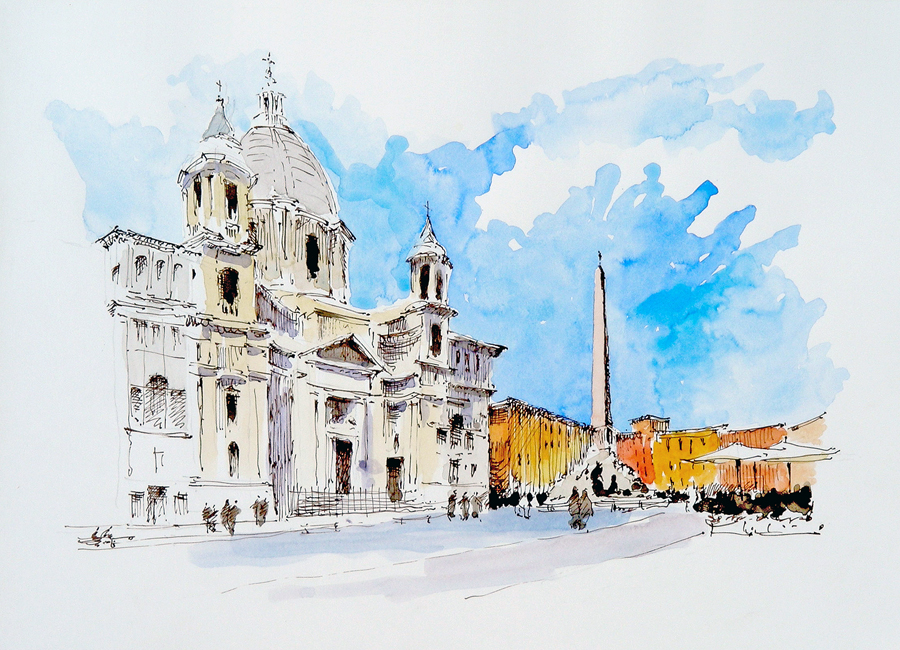
Matthew Brehm, drawing with students in Rome, Piazza Navona. Watercolor and ink.

Simonetta: I agree. I had a weekly figure-drawing session too, with Spanish painter Pedro Cano that has been a very intense, almost shocking experience: 30 minutes sessions on 50x35 cm. paper with no pencil admitted. Some (strange) drawings of mine here. I like to draw figures from ancient statues, for instance at the Archeological Museum, much more easy.

Afrodite
Simo Capecchi, Archeological Museum in Neaples. Watercolors on Arches paper 20x30. 20 minutes.

Matthew: Do you make plans in advance to sketch particular subjects, or are you more spontaneous?

Simonetta: I have dedicated sketchbooks like: Naples ink, Naples watercolors, Appennins, Bologna... for places or cities where I often go, I start a new book for each trip or long vacation and I have a small sketchbook for daily life, conferences and unplanned drawings. I also made sketchbooks as a project, like these ones for an exhibition, on a square in Bologna and about two days in Paris.

Matthew: I have some dedicated sketchbooks as well: University of Oregon campus, University of Idaho campus, and I collect my loose sheet sketches into portfolios for a particular time – such as each summer I have spent in Rome. I am trying to simplify, and use only one sketchbook for notes, journal entries, and impromptu sketches, but it’s not easy because I enjoy the properties of different books and papers. Most often, I don’t make plans to draw something specific, but occasionally I will see a certain kind of sunlight on a building and make a mental note to return at that time another day. This happens in Rome very often, because I am usually busy with students and need to come back to sketch when I have free time.

Simonetta: I know you are leaving for Rome again, good luck with your students and see you soon, in Naples and then in Portland!

Second part of this post will follow in a few days...

Friday, May 14, 2010

Symposium schedule

Things are starting to get even more exciting. Here's how the schedule is shaping up! Click on tabs below to see the schedule for each day and use the scroll bar to the right to navigate each sheet.


>>May 18 update: Registered participants are now being contacted to sign up for field sketching sessions in the order in which they registered. We hope to be caught up with all the people who have already registered within the next couple of weeks.

Wednesday, May 12, 2010

Postcards from Portland

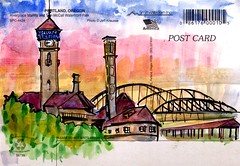
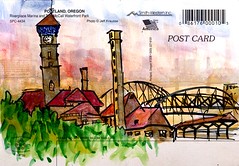
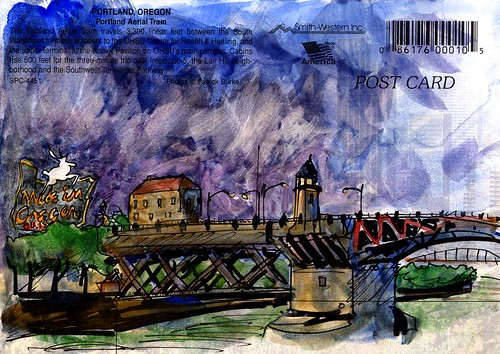
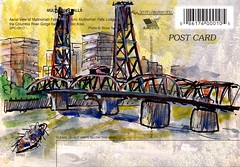
I once regarded sending postcards to friends and family while traveling a thankless chore. Then I started Urban Sketching! It may still be a chore, but it's far from thankless.

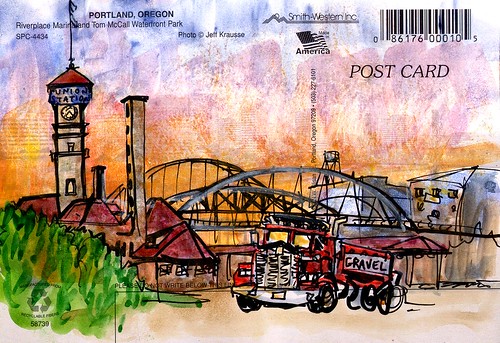
The main lesson I've learned since doing these two years ago is that it's better to use proper watercolor paper in postcard-form than attempt sketches on the slick, already-printed-on backs of commercial postcards.

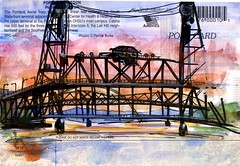
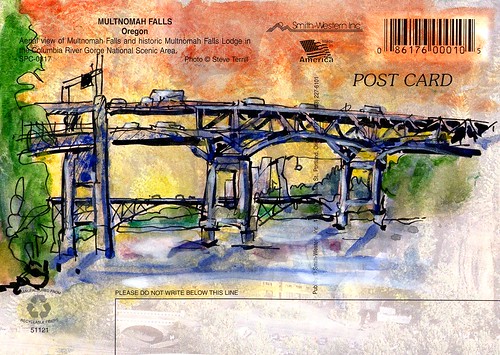
pdx postcards 9 pdx postcards 3

There's no need to think up words, and even if you sketch the same thing for multiple people, each version will be unique.

pdx postcards 7

pdx postcards 5 pdx postcards 2

I promised you bridges, didn't I?

pdx postcards 1

pdx postcards 4 pdx postcards 8

pdx postcards 6

(I did quite a few more than these, but didn't have a chance to scan them all before they were mailed.)

Monday, May 10, 2010

Portland: Bike City


For sketchers who are also bike enthusiasts, Portland is a perfect place to visit and enjoy from a two-wheel human-powered machine. Instead of 'sketchcrawling,' you can go 'sketchbiking.' I think we should try that during one of the Symposium field sketching sessions. A bike ride will be a perfect fit for the 'urban nature' theme.

Friday, May 7, 2010

Urban sketching themes

Hi sketchers, we are fine-tuning the Symposium's schedule and will release it by the end of next week, along with instructions on how to sign up for each field sketching session.

We are scheduling time for 36 sketching sessions and 20 lectures over the 3 days so everyone has the opportunity for one-on-one interaction with the instructors. It's going to be a great event!

Field sketching sessions will cover six different themes. The first 3 themes are related to the main types of subject matter a sketcher will find when exploring a city: people (pedestrians or patrons depending of the scene being outdoors or inside a locale,) architecture (buildings, houses, streets, industry,) and nature (parks, water, trees.) The second group of themes covers elements related to style and technique: composition (horizon line, foreground and background elements,) color (wet vs. dry media,) and line (pencil, pen, brush, etc.)

Here are some highlights about the themes:

  • Urban people: How do you incorporate people into a sketch that is basically a street scape? Drawing a crowd. People in the foreground and background of the same scene. Close-ups and portraits. How to connect with your subjects.
  • Urban architecture: Basics of perspective. Overcoming the fear of perspective. What can architects learn from artists and vice versa.
  • Urban nature: Flora and water add life to the urban landscape. How can they give life to your sketches. Line versus color when drawing water and trees.
  • Urban composition: A well composed scene is half of the sketch. How to identify the right composition before starting to draw. Basic layout principles.
  • Urban color: How to use color on location. Best tools. Color palettes. Wet versus dry media. Understanding values is the first step to getting color right.
  • Urban line: Minimal lines can be enough to make a powerful sketch. How to develop quality line work. How to add depth and texture to your line work.

Registration is almost two thirds full already, so if you are considering attending we encourage you to do so as early as possible in order to secure your spot.

Stay tuned for more information and don't hesitate to contact us if you have any questions.

We are looking forward to meeting you in Portland!

Monday, May 3, 2010

Some of Portland's Waterways

For most of my life, I thought Portland was on the Pacific Ocean, or at least on an adjoining bay or harbor. In fact, it's quite a ways inland and not at all a coastal city. But Portland is a river city--it actually reminds me a lot of Pittsburgh where I grew up. They also get a lot of rain (though not in midsummer when we'll be there!) and it all makes for a very water-oriented place.

I spent a month in Portland in the summer of 2008, and these are a few of my sketches of water features, natural and human-made.

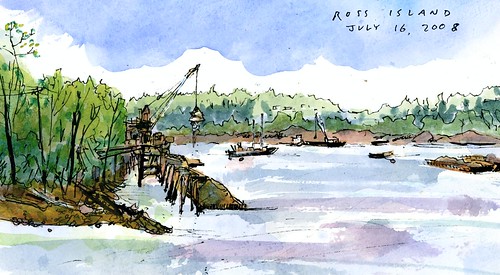
The Willamette River chops right through town, separating the East side from the West side. A bit south of downtown is the still-active Ross Island Sand and Gravel Company. Here's a view of their works, as viewed from the Springwater Corridor Trail as it emerges from Oaks Bottom Wildlife Refuge.

Ross Island (cropped)

That such a mix of the natural and industrial exists mid-city nearby to residential and commercial neighborhoods is, well, very Portland!

The Columbia river forms the northern border of the city and also acts as the state-line between Oregon and Washington. It's a bigger river but adjoins much less populated parts of town than the Willamette. The two rivers converge a bit north of the city (but an easy bicycle ride away) around Sauvie Island. I sketched this beach scene there:

Sauvie Island 2

I suspect that most river pictures of Portland feature a bridge or two (or five). The bridges are quite indeed sketchable. But I'll save my bridge sketches for another post.

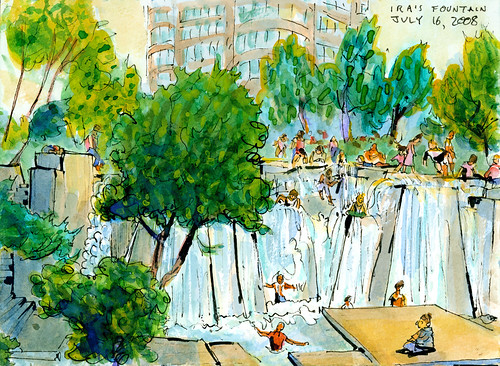
Portland is also home to some tremendously cool public fountains, fountains that the public are very much encouraged to get wet in! On a hot summer's day, can you imagine anything better in the middle of downtown than Ira's Fountain?

Ira's Fountain

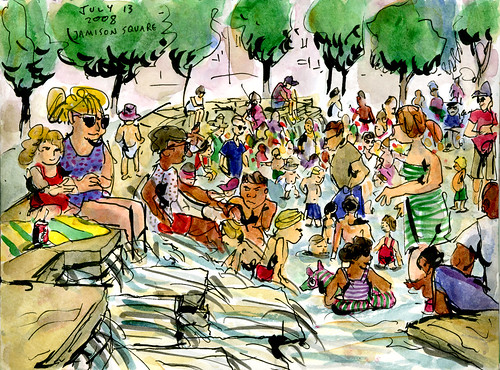
I can't even imagine Ira's Fountain--with its cliffs, falls, and pools--being legal anywhere else in the US. If you want a mellower fountain, perhaps you'd prefer Jamison Square, which has its very own artificial tides.

Jamison Square

(The Salmon Street Springs fountain is also lots of fun. I don't have a sketch of it, but check out the one Gabi did.)